To drive a dune buggy on the Al Badayer dunes, you follow your guide in a slow convoy, keep a steady and gentle throttle, climb dunes straight on, ease off before each crest, come down straight with light braking, and turn only on flat or gently sloping sand. No driving licence is needed, only photo ID.
Key takeaways
- Every buggy ride with Dune Buggy Dubai runs in the Al Badayer red dunes, about 45 to 60 minutes from Downtown Dubai, with a guide leading the convoy.
- Adults drive with photo ID. No driving licence is needed because the rides run on private desert terrain, and each driver signs a liability form at check-in.
- Smooth throttle matters more than speed. Sand rewards steady, even pressure and punishes sudden stabs on the pedal.
- Go up and down dunes straight, never across the face of a slope, and ease off before every crest.
- If the buggy bogs down, stop, stay in your seat and signal the guide. Do not spin the wheels.
- The passenger has a real job: hold on, keep arms inside the roll cage, watch the buggy ahead and pass on what they see.
- Three buggies are on offer for 30 minutes: 2 Seater Polaris RZR 1000cc at AED 600 per buggy, 4 Seater Polaris RZR 1000 CC at AED 800 per buggy and 2 Seater Can-Am Maverick X3 at AED 999 per buggy.
Can a beginner drive a dune buggy in Dubai?
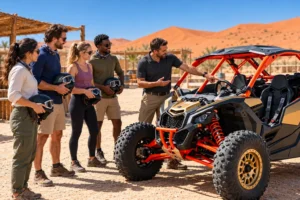
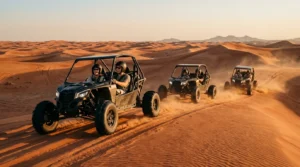
Yes. Many visitors have never driven on sand before, and the ride is set up with that in mind. Before you set off, you get a safety briefing, a helmet and goggles, and the guide shows you the controls of the buggy you booked. The guide then drives in front, picks the line through the dunes and sets the pace for everyone behind.
That means a beginner does not need to read the desert or choose a route. Your job is to drive smoothly, keep your place in the convoy and follow the line the guide takes. The technique in this guide is about doing that well, so the half hour feels controlled rather than rushed.
Who can drive is simple. Drivers are adults with photo ID. No driving licence is needed, because the rides run on private desert terrain. A liability form is signed at check-in. If you have a question about age, height, weight, pregnancy or a health condition, message the team before you book, because those answers depend on your situation. For the full picture of the rules, see our guide to self drive dune buggy rules, licence, age and safety.
What happens at the briefing before you drive
The briefing is where your driving starts, so it is worth giving it your full attention, even if you have driven off road before. It is short and practical. The guide usually covers:
- How to sit, where to put your hands and how to fasten in.
- The pedals and any gear selector on your buggy, and how to start and stop.
- How the convoy works: who leads, how to follow and what the hand signals mean.
- What to do if you want to slow down, stop or swap seats.
- What to do if the buggy gets stuck.
Ask questions here. If something on the buggy feels unfamiliar, such as the seat position or how the steering feels, say so before the convoy moves. It is far easier to fix a seat or a strap on flat ground than halfway up a dune.
Bring your photo ID to the check-in, and wear closed-toe shoes. Sandals and flip-flops are not suitable for working the pedals. High-SPF sunscreen and sunglasses for the drive out are useful too, with a spare T-shirt for the drive back.
How do you drive a dune buggy on sand dunes?
Driving on sand is different from driving on a road in one main way: the surface moves. Soft sand gives under the tyres, so the buggy needs steady drive to keep floating over it. Too little throttle and it sinks. Too much, too suddenly, and the wheels dig in or the buggy slides. The skill is in finding the even middle and holding it.
Sit right and hold the wheel properly
Sit back in the seat with your back against it, not hunched forward. Adjust until you can press the pedals fully without stretching. Hold the steering wheel with both hands, at roughly a quarter to three, with your thumbs resting on the rim rather than wrapped around the spokes. On rough sand the wheel can kick, and loose thumbs keep your hands safe.
Keep your helmet strap snug and your goggles down. Sand is fine and gets everywhere once the convoy is moving.
Use the throttle like a dimmer, not a switch
The most common beginner habit is treating the throttle as on or off. On sand that makes the buggy lurch, which is uncomfortable for your passenger and hard to control. Instead, press and release gradually. Think of it as a dimmer switch: you are turning the power up and down, not flicking it.
On flat sand, find a steady pressure that keeps you at the convoy's pace, and hold it. If you need to slow down, ease off the throttle first and let the sand slow you. Soft sand brakes the buggy quite well on its own. Use the brake pedal gently and early, not hard and late.
Steer with small movements
Sand gives less grip than tarmac, so big, sharp steering inputs can make the buggy slide or dig a front wheel in. Make small, smooth corrections and give the buggy a moment to respond. If you turn the wheel and nothing seems to happen, resist the urge to turn it further. Ease the throttle slightly instead, and the front will usually start to follow.
Look ahead, not at the bonnet
Your eyes steer the buggy more than you think. Look at the buggy in front and the sand a little beyond it, not at the ground right in front of your wheels. Looking ahead lets you see where the guide is going, spot changes in the slope early and react calmly.
Climbing a dune: straight up, steady power
Climbing is where most first-time drivers either stall in the soft sand or rush the top. A good climb has three parts.
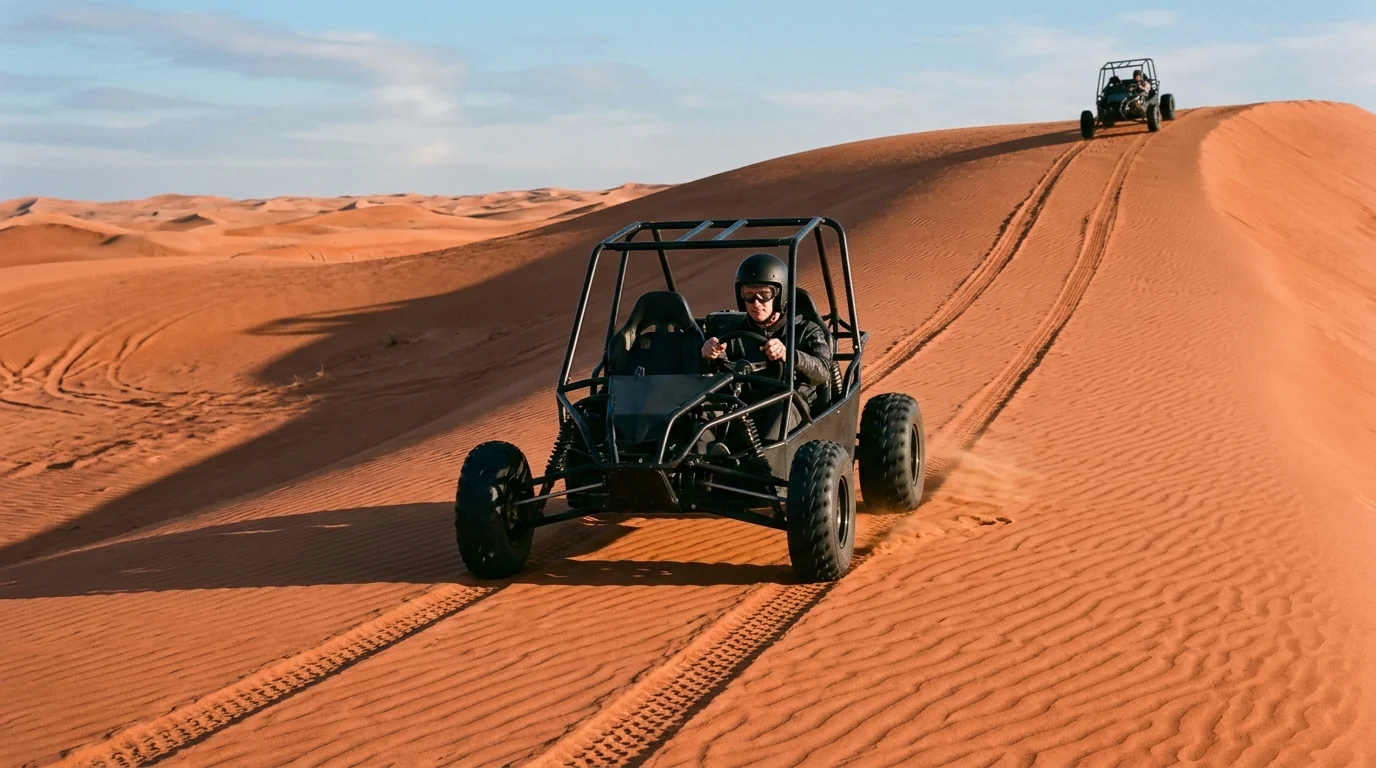
- Line up straight. Point the buggy straight up the face of the dune, the same line the guide took. Climbing at an angle across the slope makes the buggy lean, which is the position you want to avoid.
- Build steady power before the slope. Add throttle smoothly on the flat just before the climb, so you arrive with momentum. Then hold an even pressure all the way up. Do not stab at the pedal halfway.
- Ease off before the crest. As you near the top, lift off the throttle a little so you arrive at the crest slowly and in control. You cannot see what is on the other side of a crest until you are there, so arriving gently matters.
If the buggy loses momentum on the way up and starts to slow right down, do not try to turn around on the slope. Keep the wheel straight, stop, and wait for the guide's signal. Reversing straight back down the line you came up, slowly, is usually the answer, and the guide will talk you through it.
Cresting and coming down a dune
The crest is the moment people remember. With good technique it feels smooth rather than dramatic.
At the crest
Arrive slowly, with the wheel straight. As the front of the buggy tips over the top, keep a light, steady foot. You want the buggy to roll over, not leap over. Follow exactly where the guide went over, because the guide has already chosen a place where the far side is safe.
On the way down
Coming down a dune, gravity does the work. Point the buggy straight down the slope, the same as on the climb. Keep the steering straight and still. Use a little throttle or a little brake to keep the speed gentle and even, but avoid braking hard. A hard stop on a soft downhill slope can make the back of the buggy want to slide sideways.
Lean back into your seat and let the buggy settle into the sand. At the bottom, ease back onto the throttle gradually as the ground flattens out.
Never drive across the face of a slope
This is the single most important rule of dune driving. Driving sideways across a steep slope makes the buggy tilt toward the downhill side. Climb straight, descend straight, and only turn when you are on flat or gently sloping ground, such as the top of a wide ridge or the floor between dunes. If you are unsure whether a slope is too steep to turn on, it is. Follow the guide's line.
Turning in soft sand
Turning is the part of dune driving that catches people out, because soft sand piles up in front of a turned wheel and slows the buggy. To turn well:
- Pick the right place. Turn on flat sand or a gentle slope, not on the side of a dune.
- Keep a little power on. Hold a steady, light throttle through the turn. If you lift off completely, the front wheels can plough into the sand.
- Make the turn wide. A wider, gentler arc is easier on sand than a tight one.
- Unwind smoothly. As the buggy comes round, straighten the wheel gradually.
If the buggy starts to slide in a turn, ease off the throttle slightly and straighten the steering. Do not jerk the wheel the other way.
Keeping your place in the convoy
The convoy is what keeps the ride safe and calm, so how you follow matters as much as how you steer. There is no fixed number to learn here. The right gap is one where you can always see the buggy in front clearly and could stop without rushing if it stopped.
A few habits help:
- Follow the leader's tracks. The guide picks the line. Driving in the same tracks means you are on sand the guide has already judged.
- Do not overtake. Stay in your place unless the guide waves you on.
- Leave more room on climbs. If the buggy ahead slows near the top of a dune, you need space to wait at the bottom, not halfway up.
- Let the dust settle. If you are driving into the sand thrown up by the buggy ahead, you are too close. Drop back until you can see clearly.
- Watch the guide's signals. The briefing explains them. A raised hand or a stop signal means ease off and wait.
If you want to slow down or stop, signal to the guide, slow gradually and pull to the side the guide indicates. The convoy can wait.
What to do if the buggy gets stuck
Getting stuck in soft sand is normal, and it happens to experienced drivers as well. The way you respond decides whether it takes a moment to fix or longer.
- Stop pressing the throttle. If the wheels are spinning and the buggy is not moving, more power only digs the wheels deeper.
- Stay in the buggy. Keep your helmet on and stay seated.
- Signal the guide. Raise a hand and wait. The guide will come back to you.
- Follow the guide's instructions. The guide may ask you to reverse gently along your own tracks, turn the wheel a certain way, or let them move the buggy.
Do not try to dig, push or rock the buggy on your own initiative. The guide knows how to free a buggy on that patch of sand.
What does the passenger do?
The passenger seat is not a free ride. A good passenger makes the driver's job easier.
- Hold on with both hands. Use the grab handles, not the driver's arm.
- Keep arms and legs inside. Everything stays inside the roll cage at all times.
- Sit back and stay relaxed. Bracing hard makes the bumps feel bigger. Sit into the seat and let it move with the buggy.
- Be a second pair of eyes. Watch the buggy in front and the guide's signals, and tell the driver if you see the convoy slowing.
- Speak up. If the pace feels too much, say so. The driver can ease off and the guide can be told at the next stop.
If two people in a 2 Seater both want to drive, ask the team when you book how swapping works on your ride, because it depends on the slot and the guide's plan for the convoy.
Driving the 4 Seater: looking after rear passengers
The 4 Seater Polaris RZR 1000 CC carries four people, so the driver has three passengers to think about, including two in the back who cannot see the slope ahead as clearly. A few extra habits help:
- Be even smoother. Bumps and sudden throttle changes feel stronger in the back. Slow, steady inputs keep everyone comfortable.
- Call out what is coming. A simple "climbing now" or "crest coming" lets the rear passengers brace and enjoy it.
- Check in at stops. When the convoy pauses, ask the back row how they are finding the pace.
The 4 Seater is priced per buggy, so the AED 800 per buggy covers the four seats. If you are choosing between the two sizes, our 2 seater vs 4 seater dune buggy guide compares them in detail.
Does the Can-Am Maverick X3 drive differently from the Polaris RZR?
Each buggy has its own feel, and the briefing shows you the controls of the one you booked. The technique in this guide applies to all three: smooth throttle, straight climbs and descents, easing off at the crest and turning on flat sand. If you have a specific question about how the 2 Seater Can-Am Maverick X3 compares with the 2 Seater Polaris RZR 1000cc for a first drive, message the team on WhatsApp and they can talk you through it.
Here are the three buggies side by side, with their 30 minute prices:
| Buggy | Seats | 30 Min price | Unit | 60 and 120 Min |
|---|---|---|---|---|
| 2 Seater Polaris RZR 1000cc | 2 | AED 600 | per buggy | Ask on WhatsApp |
| 4 Seater Polaris RZR 1000 CC | 4 | AED 800 | per buggy | Ask on WhatsApp |
| 2 Seater Can-Am Maverick X3 | 2 | AED 999 | per buggy | Ask on WhatsApp |
Every buggy ride includes a guide, a helmet and goggles, fuel, a safety briefing and unlimited mineral water. Only the 30 minute prices are published. For 60 and 120 minute rides, the price is on request on WhatsApp.
Which time slot is easiest for a first drive?
Rides run every day from 5:00 AM to 8:00 PM, and you choose the start time on the booking form. For a first drive, a cooler slot makes it easier to concentrate. You are wearing a helmet and goggles, and heat makes that harder work.
The best season is October to April. In summer, the rides run early, from about 5:00 AM to 8:00 AM, to avoid the heat. A morning slot in the cooler months is a comfortable choice for many first-time drivers, because the light is clear and the air is still fresh. For more planning advice on slots, clothing and getting there, see our dune buggy Dubai tips for planning your Al Badayer ride.
Dune buggy driving tips for beginners: a quick checklist
If you only remember a handful of points from this guide, make it these:
- Listen to the whole briefing and ask about anything unclear.
- Sit back, both hands on the wheel, thumbs on the rim.
- Press and release the throttle gradually.
- Climb straight, ease off before the crest, descend straight.
- Turn only on flat or gentle ground, with a little power on.
- Keep a gap that lets you see the buggy ahead clearly.
- If stuck, stop the throttle, stay seated and signal the guide.
- Passengers hold the handles and keep everything inside the cage.
How this guide fits with your first ride
This guide covers the technique of driving on the dunes. It does not repeat the full order of the day, from pickup to check-in to the drive back. For that, read your first dune buggy ride in Dubai, step by step. For safety rules, licence questions and who can drive, the self drive guide linked above covers it.
Buggy pickup is extra and available from Deira, Downtown, Business Bay, JBR and Marina. Payment is made online in AED by card, and a written confirmation follows with the meeting pin for Al Badayer. The office at Jumeirah Beach Centre, Jumeirah Road, is for booking only. No ride starts there. For changes to a booking, read the cancellation policy.
In short
Driving a dune buggy at Al Badayer comes down to a few calm habits: gentle throttle, straight lines up and down, easing off at every crest, turning only on flat sand and keeping a clear gap in the convoy. The guide leads, picks the line and helps if you get stuck, so a beginner can focus on driving smoothly.
To pick your buggy and time slot, see the dune buggy Dubai rides page or chat with the team on WhatsApp at +971 52 440 9525.